Have you ever watched a small piece of broken branch moving across the ground? I am not talking about a branch blowing in the wind. I’m talking about a piece of branch that gets up and walks away. Impossible? Well… you might be surprised if you encountered the larva of the buff-tip moth that lives in Europe and Asia. If you look carefully at the image, you can see legs on some of the twigs – and when not disturbed, the “branch” just walks away! What Intelligent bird would choose to munch down on a piece of broken branch?
A Chiffon margarine commercial in the 1970s had the story line “It is not nice to fool Mother nature” – but “Mother Nature” is a master of deception! I have been interested in the general topic of antipredation mechanisms – strategies employed, in my case, by insects to avoid being eaten primarily by birds. The marine world is awash with examples of species that display cryptic coloration, form resemblance, or strange behaviors to avoid their predators. We will limit our short discourse here to examples from the world of insects.
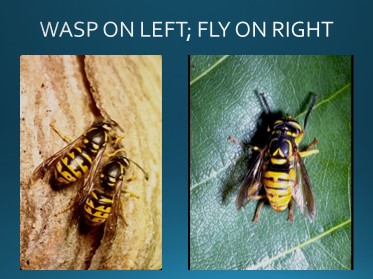 I became interested in this topic in graduate school and one of my first publications I co-authored with a professor examined when flies that mimic wasps or bumble bees are active compared to the fledging time of insectivorous birds. We found that the largest number of mimetic flies are present in the spring and are largely absent by early summer. Another smaller group of species appears again in the fall. Why this seasonal difference in the mimetic fly populations? We discovered a strong correlation between the flight time of the flies, the fledging time of the insectivorous bird species in the area, and the abundance of wasps and bumble bees. As the season progresses, the population size of social wasps and bumble bees rapidly increases. By the time young birds fledge, they only encounter wasps and bumblebees – and rapidly learn to avoid them. One bad experience is sufficient to condition a bird for life!
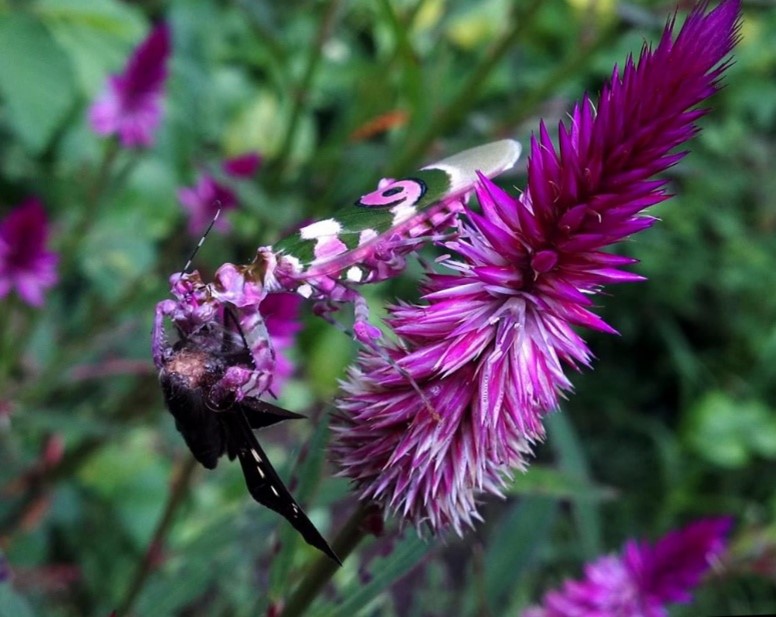 Occasionally, it is the predator that turns the table on the prey. Have you encountered a predator that employs cryptic coloration and/or form resemblance to enhance their predation effectiveness? I am sure you have if you have looked carefully at flowers. Often you will see a cryptically colored crab spider lying in wait for an unsuspecting moth, fly, or wasp. However, some praying mantids are also highly cryptic such as the example in the photo that seemingly disappears as it lies in wait next to a flower as unsuspecting moths come seeking a rich source of nectar. It is amazing what you can see if you only take the time to look. I encourage you to enjoy the amazing diversity of God’s creation. Although we are admonished to be truthful in all our words and deeds, it seems that God has allowed his non-human Creation to employ more devious means in its “survival of the fittest”.
Our Prayer: Lord, we are awe struck by your amazing creation! Beauty beyond our imagination. We pray your blessing upon us as we daily love and seek to protect your bountiful Creation.
Thanks for caring!
— Joe Sheldon
Direct comments to Joe Sheldon at jksheldon43@gmail.com