Have you noticed that creation seems to burst into song in April and May? For those of us who enjoy the spectacular beauty of birds, this spring chorus is music to our ears and is often referred to as the dawn chorus when many species of birds break into full song shortly after sunrise. Scientists have for years been studying this phenomenon and questioning its significance and reason from a biological perspective. A recent study, titled “Why is the early bird early? An evaluation of hypotheses for avian dawn-biased vocal activity” published in the journal Philosophical Transactions of the Royal Society B sought to answer this question.
A variety of hypotheses have previously been proposed. These include 1) the male birds are marking their territory after being inactive at night, 2) they are communicating about food, 3) they choose to sing best in the early morning because the acoustic transmission of their songs is maximized in the cool moist dawn air, 4) they sing in the dawn low light because it is a poor time to forage for food, 5) they are just warming up their singing apparatus after at night’s sleep, 6) or perhaps it’s related to the female’s preferred time to mate in the early morning. In conclusion, the paper did not reach a definitive answer but suggested there could be multiple reasons for the dawn chorus. It has also been suggested that physiologically birds singing takes a lot of energy and the amount of singing during the spring breeding season far exceeds the biological necessity for that activity. So why the excessive singing? Perhaps there is a deeper meaning. Let’s move on beyond singing to consider other interesting animal behaviors.
Have you noticed that on clear windy days crows seem to exuberantly hang on the wind currents almost as if they are playing? What about young deer fawns prancing around on their spindly legs as if they are just having fun. I’ve noticed porpoises and dolphins riding the bow waves of boats similar to humans riding surfboards. Is that behavior just for the excitement they enjoy? And orca as well as other whale species often loft themselves into the air only to come down with a grand splash when they hit the water. Is there a biological explanation for these types of behaviors? Science often assumes that there must be a biological answer that clearly benefits the organism and that we should not attribute human centered reasoning to animals.
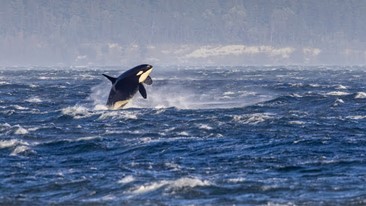
Orca in Penn Cove, photo by Jann Ledbetter
But perhaps there is a deeper explanation! My friend Cal DeWitt, founder of Au Sable Institute for Environmental Studies, suggests that the birds are just praising the Lord in their early morning exuberance! And what about the orca you see lofting its full body into the air for a subsequent grand splash? Psalm 104:26 suggests that leviathan was formed just to frolic in the ocean! What a grand statement! God’s creatures play! And in their own way they are praising their Lord by their singing and their joy-filled activity. What really is the song of a humpback whale saying? Perhaps we should tune our own ears to hear more accurately the songs of God’s nonhuman creation. What might they be saying to us?
Our Prayer: Lord, please open our eyes and ears to music and sights of your creation that daily proclaim the works of your hands!
Thanks for caring!
— Joe Sheldon
Direct comments to Joe Sheldon at jksheldon43@gmail.com